Women of science in literature
Literature, like History, has long been a mirror reflecting an almost exclusively male science. Women, when they appeared, were confined to secondary roles. But a new generation of authors is reclaiming these forgotten figures to give them back a voice and a story.
The invisible assistant: a persistent stereotype
For decades, the most common representation of women in science was that of the assistant, or the discreet wife of the genius. Think of the image of Rosalind Franklin, often reduced to a footnote in the history of DNA, while Watson and Crick took the spotlight. Literature often perpetuated this cliché, valuing feminine intuition but reserving discovery for men.
The icon and the exception
The only figure who escaped this rule was Marie Curie. However, by celebrating her as a quasi mythical exception, literature reinforced the idea that scientific success for women was unusual. She became the main woman representing the Matildas, those other women whose contributions were minimized, forgotten, or stolen, but less impressive.
"The novel allows us to repair where the archive falls short"
The novel as a tool of rehabilitation
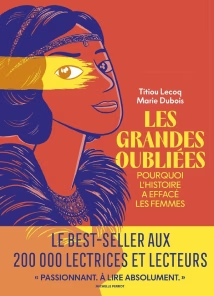
Titiou Lecoq, The Forgotten Greats, October 2021
Fortunately, the trend is reversing. From works like The Forgotten Greats by Titiou Lecoq to novels, literature is becoming a powerful tool for rehabilitation. Authors like Marie-Ève de Grave with The Life of Marthe Gautier or Conception by Sakuya from Ouristoria attempt to explore the inner lives, doubts and struggles of these women.
By giving them psychological depth and context, the novel doesn't just correct an oversight, it does justice. It transforms names erased from archives into heroines, inspiring readers to rewrite in turn, questioning official history.