My researcher, Henrietta Swan Leavitt
At the beginning of the 20th century, a human "calculator" at Harvard Observatory made a discovery that would change astronomy forever. Her name was Henrietta Swan Leavitt, and her work became the key to measuring cosmic distanceyet her name was erased from the history books.
The "calculator" in the shadows
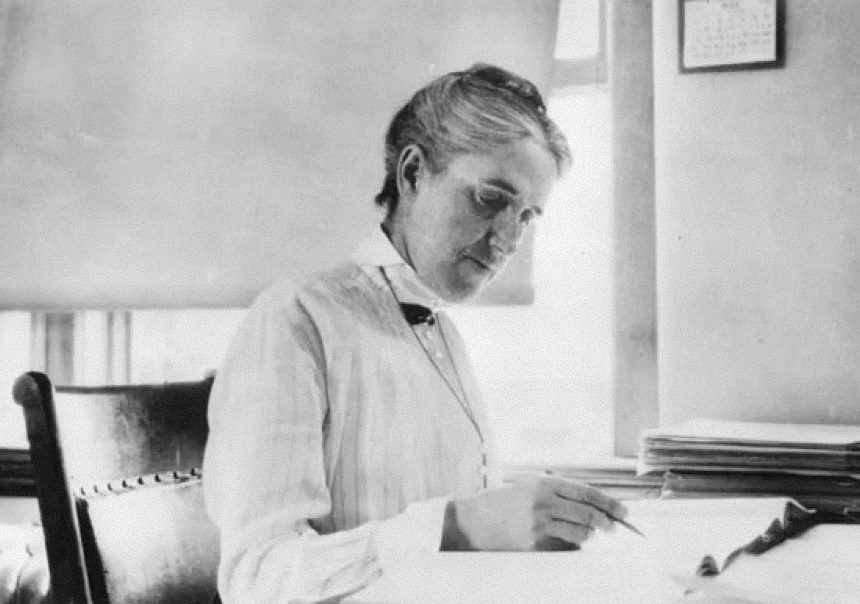
At that time, women were not allowed to use telescopes. Leavitt was hired as a human calculator, paid to analyze photographic plates taken by male astronomers. Her job measure, count, classify thousands of stars repetitive and undervalued work, but requiring extreme precision.
A law that changes everything
By observing thousands of variable stars called Cepheids, Leavitt made an astonishing discovery, there is a direct relationship between the pulsation period of a Cepheid and its absolute luminosity. In other words, the slower a star blinks, the brighter it is.
"Leavitt provided the key to unlocking the distances to the far reaches of the universe."
A legacy stolen by the Matilda Effect
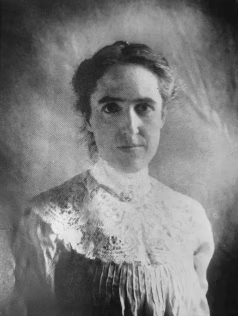
This Leavitt's Law became the missing piece for astronomers to measure unimaginable distances. Using her work, Edwin Hubble was able to prove in 1924 that Andromeda was a distant island universe from ours, and that the universe was expanding.
Yet, it was Hubble who became a global icon. Leavitt, she, never received official recognition. She died in 1921, without knowing that her law had revolutionized our understanding of the cosmos. Even today, when we speak of "Hubble's discoveries," we forget that everything was built on the calculations of this anonymous woman.